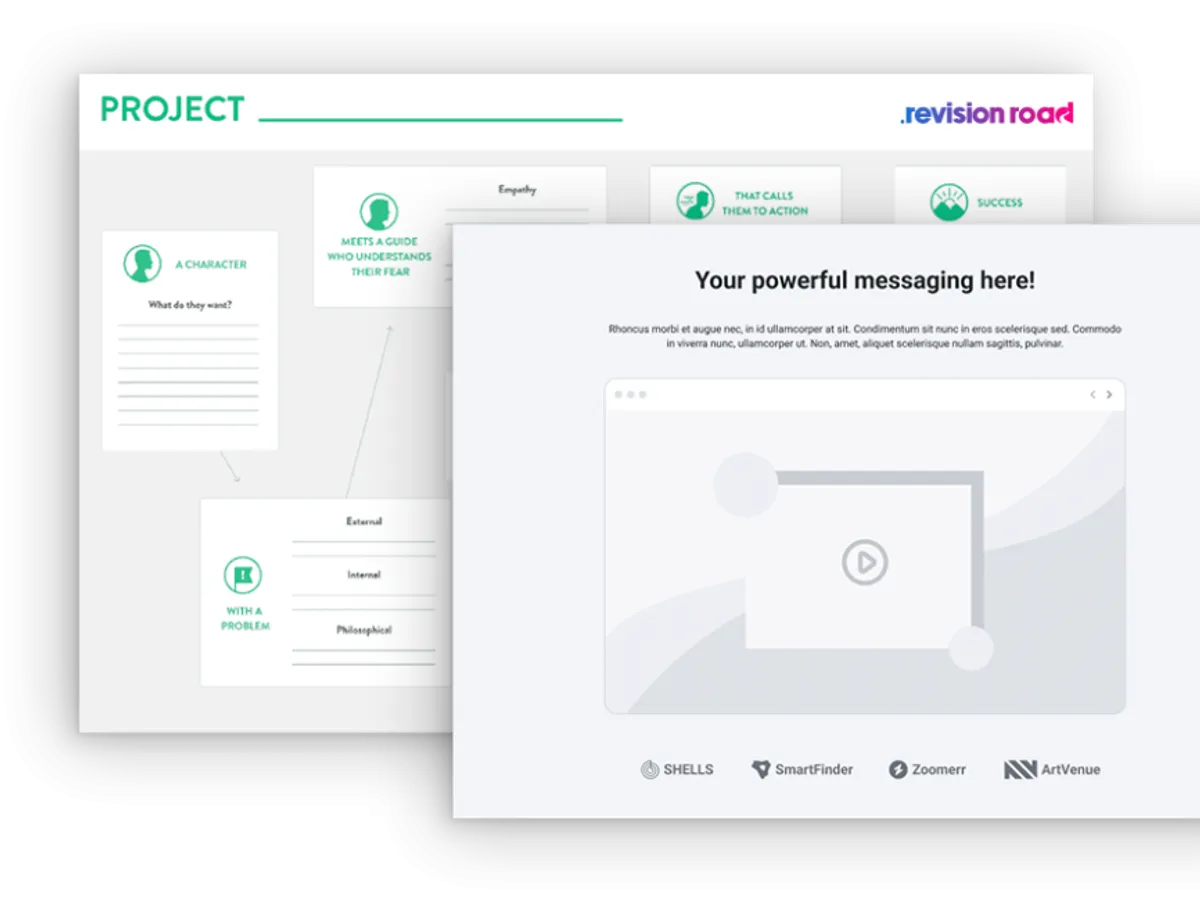
Crafting a compelling website narrative is essential for entrepreneurs and businesses looking to connect with their audience and drive meaningful engagement. The StoryBrand framework, developed by Donald Miller, offers a proven methodology for clarifying your message and positioning your brand in a way that resonates deeply with your customers. By leveraging the power of storytelling, StoryBrand transforms the way businesses communicate by replacing confusing, self-centered messaging with clear, customer-focused narratives that inspire action.
Whether you’re building a new website from scratch or refining the messaging on your existing site, these five StoryBrand principles provide a practical roadmap for creating a narrative that cuts through the noise and speaks directly to your audience’s needs, desires, and challenges.
Key Takeaways
- Making your customer the hero of your story shifts the focus from your brand to your audience, creating a more engaging and relatable narrative.
- Clearly identifying the problem your customer faces, at external, internal, and philosophical levels, builds empathy and positions your brand as the solution.
- Positioning your brand as the guide rather than the hero establishes trust and authority without alienating your audience.
- Laying out a simple, clear plan removes confusion and gives your customers a straightforward path to success.
- Including direct and transitional calls to action at key points throughout your website drives engagement and conversions.
1. The hero of the story
One of the most transformative principles in the StoryBrand framework is this: your customer is the hero, not your brand. This is a fundamental shift from how most businesses approach their website messaging. Too often, companies fill their websites with content about their history, their achievements, and their capabilities, inadvertently placing themselves at the center of the story.
But here’s the truth: your visitors don’t come to your website to learn about how great you are. They come because they have a problem, a need, or a desire, and they’re looking for someone who understands that and can help them succeed.
When you make the customer the hero of your story, you:
- Create immediate relevance: Visitors instantly see themselves in your narrative and feel that your website was built for them.
- Build emotional connection: People engage with stories where they can identify with the protagonist. When the hero is someone like them, they pay attention.
- Shift the conversation: Instead of talking about what you do, you’re talking about what your customer can achieve, which is far more compelling.
- Increase engagement: A hero-centered narrative invites visitors to participate in the story, moving from passive browsers to active participants.
The moment your customer realizes that your website is about their story, not yours, is the moment they start paying attention. That’s the power of making the customer the hero.
To apply this principle to your website, review your homepage and key landing pages. Count how many times you reference “we,” “our,” and “us” versus “you,” “your,” and “yours.” If the balance tips toward your brand, it’s time to rewrite with your customer as the protagonist. Every headline, every paragraph, and every image should reinforce the idea that this story is about them and their journey toward success.
2. The problem
Every great story revolves around a problem that the hero must overcome, and your website narrative is no different. The StoryBrand framework teaches that you must clearly articulate the problem your customer is facing, and do so at three distinct levels, to create a narrative that truly resonates.
The three levels of problem in the StoryBrand framework are:
- The external problem: This is the tangible, surface-level issue your customer is dealing with. It’s the practical challenge they’re trying to solve. For example, a business owner might need a new website because their current one is outdated and not generating leads.
- The internal problem: This is the emotional frustration that the external problem creates. Continuing the example, that business owner might feel embarrassed by their website, frustrated that their competitors look more professional online, or anxious that they’re missing opportunities every day.
- The philosophical problem: This is the deeper “why it matters” question. It speaks to a sense of fairness, justice, or how things ought to be. In our example, it might be: “A hardworking business shouldn’t lose customers because of a poor website.”
When you address all three levels of the problem on your website, you:
- Demonstrate deep understanding: Your customers feel seen and understood, which builds trust immediately.
- Create urgency: By naming the internal and philosophical problems, you tap into emotions that motivate action far more effectively than listing features ever could.
- Differentiate your brand: Most competitors only address the external problem. By going deeper, you stand apart as a brand that truly gets it.
- Strengthen your narrative: The problem is the engine of any story. Without a clearly defined problem, there’s no tension, no stakes, and no reason for the hero to act.
People don’t buy solutions to external problems. They buy solutions to internal problems. When you name the frustration your customer feels and the injustice they’re experiencing, you create a connection that goes far beyond a transaction.
On your website, make sure the problem is front and center, ideally within the first few sections of your homepage. Use language that mirrors how your customers actually describe their challenges. Avoid jargon and corporate speak. Speak to the frustration, the anxiety, and the sense that things should be better. When your visitors read your website and think, “That’s exactly how I feel,” you’ve nailed it.
3. The guide
If the customer is the hero, then your brand is the guide. Think of your brand as the Yoda to your customer’s Luke Skywalker: the wise, experienced mentor who has the knowledge and tools to help the hero succeed. Positioning your brand as the guide is one of the most powerful principles in the StoryBrand framework because it allows you to demonstrate authority and competence while keeping the focus on the customer.
A guide possesses two critical qualities:
- Empathy: The guide understands what the hero is going through. They’ve seen this problem before, they recognize the frustration, and they genuinely care about helping the hero overcome it. On your website, empathy is expressed through language that acknowledges your customer’s struggles and validates their feelings.
- Authority: The guide has the expertise, experience, and track record to help the hero succeed. Authority is demonstrated through credentials, testimonials, case studies, awards, years of experience, and the confidence with which you present your solutions.
When you position your brand as the guide, you:
- Build trust quickly: Visitors trust brands that understand their situation and have a proven ability to help.
- Avoid the ego trap: Brands that position themselves as the hero come across as self-absorbed. Guides come across as helpful, knowledgeable, and customer-focused.
- Create a natural relationship dynamic: People are wired to look for guides. When you fill that role, the relationship feels intuitive and comfortable.
- Establish credibility without bragging: Testimonials, case studies, and credentials speak for themselves when presented in the context of how they’ve helped customers succeed.
Your customers don’t need another hero. They need a guide: someone who understands where they are, knows where they want to go, and has the expertise to help them get there. Be that guide.
To implement this on your website, include social proof prominently: client testimonials, logos of companies you’ve worked with, relevant certifications, and case studies that show results. Pair this authority with empathetic language in your headlines and body copy. Phrases like “We understand how frustrating it is to…” or “You deserve a website that…” demonstrate that you see your customer as a person, not just a transaction.
4. The plan
Even when a hero has identified their problem and found a guide they trust, they won’t take action if the path forward seems unclear or risky. That’s why the StoryBrand framework emphasizes the importance of giving your customer a clear, simple plan. The plan removes confusion, reduces anxiety, and makes the next steps feel achievable.
The StoryBrand framework identifies two types of plans:
- The process plan: This outlines the steps the customer needs to take to do business with you. It answers the question, “What do I do next?” A process plan might be as simple as three steps: (1) Schedule a consultation, (2) We’ll build your custom strategy, (3) Launch your new website and watch your business grow.
- The agreement plan: This addresses the customer’s fears and concerns by listing the promises or commitments your brand makes. It answers the question, “What can I expect?” An agreement plan might include promises like “No hidden fees,” “Satisfaction guaranteed,” or “We won’t launch until you’re 100% happy.”
When you lay out a clear plan on your website, you:
- Remove barriers to action: When customers know exactly what to do next, they’re far more likely to take that step.
- Reduce perceived risk: A clear plan signals that you’ve done this before and that the process is well-defined and reliable.
- Build confidence: Customers feel reassured when they can see the entire path from where they are now to where they want to be.
- Simplify decision-making: In a world of information overload, simplicity is a competitive advantage. A three-step plan cuts through the noise.
Confusion is the enemy of conversion. If your website visitor has to think too hard about what to do next, they’ll do nothing. Give them a simple, clear plan that makes the path to success feel easy and achievable.
On your website, present your plan visually. Numbered steps, icons, or a simple timeline work well. Keep it to three or four steps at most. Use action-oriented language that focuses on outcomes. And remember, the plan isn’t about the details of your process. It’s about giving the customer clarity and confidence that they’re making the right choice.
5. The call to action
A story without a climax is unsatisfying, and a website without a clear call to action is ineffective. Your website must include bold, clear calls to action that tell visitors exactly what you want them to do next. This is where the StoryBrand framework draws a crucial distinction between two types of calls to action.
- Direct calls to action: These are the primary actions you want visitors to take, the actions that lead directly to a sale or conversion. Examples include “Buy Now,” “Schedule a Consultation,” “Get Started,” or “Request a Quote.” Direct CTAs should be prominent, repeated throughout the page, and visually distinct.
- Transitional calls to action: These are for visitors who aren’t ready to commit yet but are interested enough to stay engaged. Transitional CTAs offer value in exchange for a smaller commitment, such as “Download Our Free Guide,” “Watch the Demo,” or “Subscribe to Our Newsletter.” They move the customer further into the story without asking for a purchase.
When you implement strong calls to action on your website, you:
- Guide the customer’s journey: CTAs act as signposts, directing visitors toward the next step in their story.
- Create urgency and momentum: A well-placed CTA at the right moment can tip a hesitant visitor into action.
- Capture leads at every stage: Not every visitor is ready to buy today. Transitional CTAs ensure you don’t lose those who need more time.
- Eliminate ambiguity: When visitors land on your page, they should never have to wonder, “What am I supposed to do here?”
If you don’t ask, you don’t get. Many businesses bury their calls to action or make them so subtle that visitors miss them entirely. Be bold. Be clear. Tell your visitors exactly what to do next and make it easy for them to do it.
On your website, your direct CTA should appear in the hero section of your homepage, in the navigation bar, and at multiple points throughout the page, especially after sections that build desire or address objections. Transitional CTAs should be placed strategically as alternatives for visitors who aren’t ready for the primary action. Use contrasting colors, clear language, and prominent placement to ensure your CTAs are impossible to miss.
Conclusion
The StoryBrand framework offers a powerful lens through which to evaluate and improve your website’s narrative. By making your customer the hero, clearly defining the problem they face, positioning your brand as the trusted guide, laying out a simple plan, and including bold calls to action, you create a website experience that resonates, engages, and converts.
These five principles aren’t just theoretical; they’re practical, actionable steps that any business can implement starting today. Review your website with these principles in mind, identify where your messaging falls short, and begin making changes. The result will be a website that tells a compelling story, one where your customer is the hero and your brand is the guide that helps them succeed.