If you have searched for something online lately, you might have noticed a big change: instead of getting a long list of links, you are starting to get direct answers that are often written by AI. Whether it is Google’s AI Overviews, ChatGPT, or Perplexity, people are skipping the click and getting what they need instantly.
This shift is changing how customers discover businesses, and it is moving fast. If you are a business owner or part of a small marketing team, understanding this trend can help you stay visible, relevant, and competitive.
Here’s what’s happening:
- The global AI market is currently valued around $391 billion in 2025 and is forecast to surge nearly fivefold to around $1.8 trillion by 2030, driven by rapid adoption across industries.
- In the U.S., over 120 million people, more than 35% of the population are using generative AI tools, with platforms like ChatGPT alone boasting 88.6 million U.S. users in 2025.
- Meanwhile, zero-click searches, where users get the answer on the search results page without visiting a website are exploding. In early 2025, 60% of searches ended without any external click, compared to around 58.5% in 2024. For U.S. Google searchers, the organic click-through rate dropped to 40.3% in March 2025, down from 44.2% a year earlier.
These numbers signal more than just a trend. They show that AI is fundamentally redefining how users search and how businesses must be found. If your content doesn’t adapt to this new behavior, you risk simply disappearing from view.
Trend #1: Search is becoming more like a conversation
Not long ago, people typed short keywords into Google like “best coffee shop Chicago.” Today, they are more likely to type or speak full questions:
“Where can I find a cozy coffee shop in Chicago with Wi-Fi and outdoor seating?”
AI-powered search tools understand these natural questions and respond in full sentences, sometimes with suggestions, reviews, and maps all in one.
Why this matters for you: Customers are expecting conversation-ready answers, not just pages stuffed with keywords.
Action tip:
- Make a list of your top 5 customer questions and answer each one clearly on your website or blog.
Trend #2: AI gives answers without sending people to websites
This is called zero-click search. The AI gives the answer directly instead of sending the searcher to your site. For example, if someone asks, “How often should I service my air conditioner?” Google’s AI might show the answer instantly with no need to click anywhere.
The challenge: This can mean less website traffic. The opportunity: If AI uses your content to answer, your brand gets visibility and credibility.
Action tip:
- Use short, clear answers in your content.
- Break up long paragraphs into bullet points or numbered steps so AI can easily pull them.
Trend #3: New ways to show up in AI search results
You have probably heard of SEO (Search Engine Optimization), but now there are new approaches:
- AEO (Answer Engine Optimization): Creating content so AI can easily find and quote you when answering questions.
- GEO (Generative Engine Optimization): Making your content more likely to be cited by AI tools like ChatGPT and Perplexity.
Think of it as teaching AI about your business so it can recommend you when someone asks.
Action tip:
- Add a FAQ section to your site.
- Use clear headings (H1, H2, H3) so AI can understand your page’s structure.
- Consider adding schema markup (a kind of code that explains your content to search engines).
Trend #4: AI is making marketing faster (and smarter)
AI tools are not just changing search. They are also making marketing easier. From writing social media posts to analyzing customer data, these tools can save hours of work.
Action tip:
- Pick one AI tool to try this month. It could be a content generator, an email marketing helper, or a chatbot for your website.
How to get ready now
Here is a quick checklist to future-proof your marketing in the AI era:
- Focus on customer questions. Write content that directly answers what people ask.
- Keep your site clear and organized. Good structure helps AI read your site.
- Build trust. Reviews, testimonials, and helpful free resources can make you stand out in AI recommendations.
Looking ahead: The next 1–3 years
AI search will keep getting more personal and predictive. Instead of just showing results, it might recommend your product before someone even searches for it if it knows what they like.
Businesses that adapt early will have a huge advantage. Those that wait may find it harder to get noticed.
Conclusion
The way people find information online is changing, and so are the rules of the game. By making your content clear, helpful, and AI-friendly today, you will be in a stronger position tomorrow.
Start small. Answer your customers’ questions. Organize your site. Test one new AI tool. Over time, these small steps can add up to a big advantage in the AI-powered future of search.
FAQs
How do I know if my current website is ready for AI-driven search?
Most businesses do not realize their content structure, speed, or formatting might be holding them back in AI search visibility. A quick audit can reveal if your site is AI-friendly, from how your content is organized to whether it uses basic structured data.
My team already writes content. What is different about AI search optimization?
Traditional SEO often focuses on ranking for keywords. AI search optimization focuses on making your content easy for AI tools to understand and quote in their answers. This requires slightly different formatting and strategy.
Can small marketing teams realistically compete in AI search results?
Yes. In many cases, smaller teams can pivot faster than larger companies. Success often comes down to creating clear, authoritative content that directly answers your audience's questions.
Is optimizing for AI search the same as optimizing for voice search?
They share some similarities, such as focusing on conversational, question-based content, but AI search has unique needs like structured formatting, context-rich answers, and strategic topic coverage.
How do I track if my AI search strategy is working?
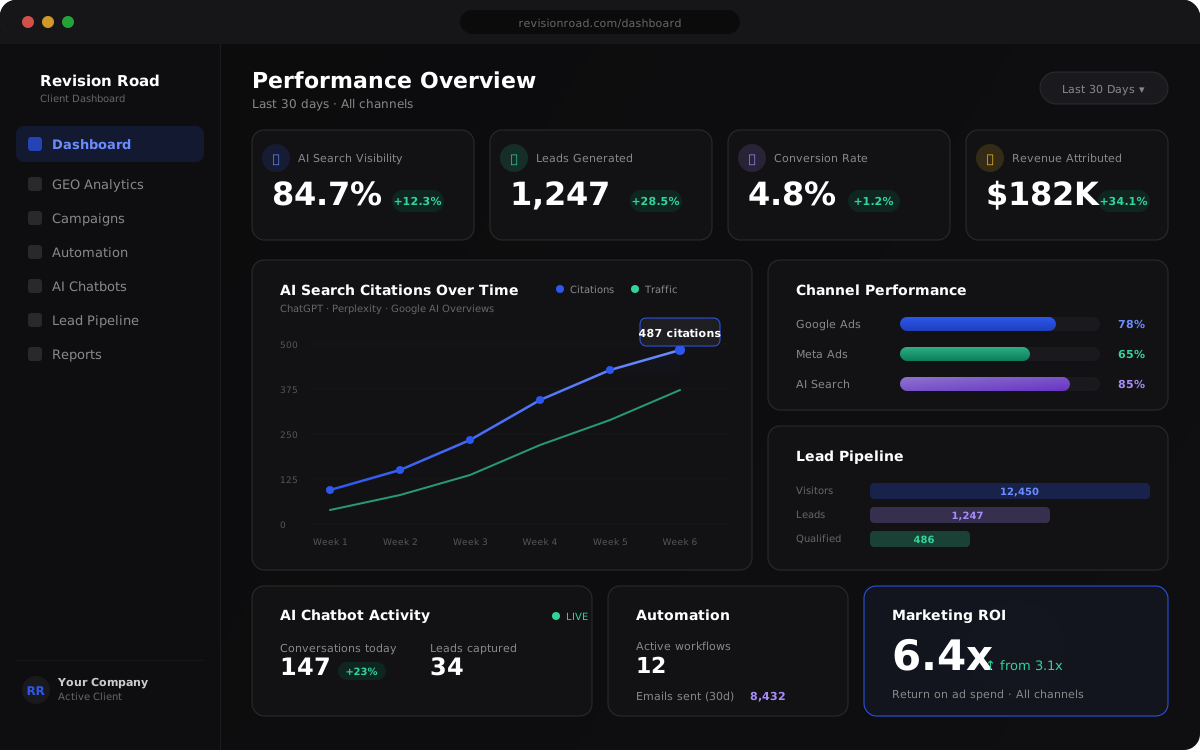
Measuring AI visibility is still evolving. While traditional analytics show clicks and rankings, AI search often impacts brand awareness even without a website visit. Tracking citations, branded search growth, and customer feedback can help measure ROI.
I am overwhelmed by the changes in search. Where do I start?
Start small. Focus on your top customer questions, organize your website content, and add a simple FAQ section. From there, you can expand into structured data, AI content formatting, and strategic topic coverage.