Having a successful online presence is no longer optional for businesses of any size. Your website is your digital brick and mortar. It’s often the first impression potential customers have of your brand, the place where transactions happen, and the hub of your marketing efforts. Just as you wouldn’t cut corners on the foundation of a physical storefront, the hosting platform that powers your website deserves careful consideration.
It’s tempting to gravitate toward budget hosting plans that promise everything for just a few dollars a month. On the surface, these deals seem too good to pass up. But beneath those attractive price tags lie hidden costs that can undermine your website’s performance, security, and ultimately your business’s bottom line.
In this article, we’ll pull back the curtain on cheap website hosting plans and explore the true costs that don’t show up on the invoice. From downtime disasters and security vulnerabilities to sluggish performance and poor customer support, the risks of bargain hosting are very real, and often very expensive.
Key Takeaways
- Cheap hosting plans frequently suffer from excessive downtime, which can result in lost traffic, revenue, and customer trust.
- Budget hosting providers often lack robust security measures, leaving your website vulnerable to hacking, malware, and data breaches.
- Slow page load speeds caused by overcrowded shared servers can drive visitors away and hurt your search engine rankings.
- Poor hosting performance reflects negatively on your brand, making your business appear unreliable or unprofessional.
- Investing in premium hosting provides better uptime guarantees, advanced security, superior support, and long-term cost savings.
The hidden risks of inexpensive hosting solutions
When a hosting provider offers plans at rock-bottom prices, there’s always a trade-off. Providers must cut costs somewhere to maintain profitability, and those cuts typically come at the expense of the features and infrastructure your website needs to thrive. Let’s examine the three most common hidden risks.
Downtime dilemmas
Downtime is the silent killer of online businesses. Every minute your website is unavailable, you’re losing potential customers, damaging your reputation, and eroding the trust you’ve worked so hard to build. Cheap hosting providers often pack hundreds or even thousands of websites onto a single server to maximize their margins. When one site on that server experiences a traffic spike or a technical issue, every other site on that server can be dragged down with it.
Budget hosts typically offer uptime guarantees of 99% or less, which sounds impressive until you do the math. A 99% uptime guarantee still allows for over 87 hours of downtime per year. That’s more than three and a half days where your website could be completely unreachable. Compare that to premium hosts that guarantee 99.9% or even 99.99% uptime, and the difference becomes stark.
Consider the impact on an e-commerce site that generates $1,000 per day in revenue. Even a few hours of downtime during peak shopping periods could translate to hundreds or thousands of dollars in lost sales, far exceeding the “savings” from a cheap hosting plan.
Security vulnerabilities
Cybersecurity threats are growing more sophisticated every day, and your hosting environment is your first line of defense. Cheap hosting providers often lack the resources to implement comprehensive security measures, leaving your website, and your customers’ data, exposed.
Common security shortcomings of budget hosting include:
- Outdated software: Servers running outdated operating systems, PHP versions, or control panel software with known vulnerabilities.
- Lack of SSL certificates: Some budget hosts charge extra for SSL, or don’t offer it at all, leaving data transmissions unencrypted.
- Minimal firewall protection: Without robust firewalls and intrusion detection systems, your site is an easy target for attackers.
- Infrequent backups: Many cheap hosts either don’t offer automatic backups or perform them so infrequently that recovering from an attack means losing days or weeks of data.
- Shared IP addresses: When you share an IP with hundreds of other sites, one compromised site can put your site at risk, and a blacklisted IP can affect your email deliverability.
The cost of recovering from a security breach, including data recovery, legal fees, customer notification, and reputation repair, can easily reach tens of thousands of dollars. That’s a steep price to pay for saving a few dollars a month on hosting.
Limited resources
Cheap hosting plans are inherently resource-constrained. You’re sharing CPU, RAM, disk space, and bandwidth with a large number of other websites. When your site needs more resources, whether during a marketing campaign, a seasonal spike, or simply as your business grows, you’ll hit walls that can cripple your performance.
Resource limitations manifest in several ways:
- CPU throttling: When your site uses more than its allocated share of processing power, the host may throttle your account, causing pages to load slowly or not at all.
- Memory caps: Limited RAM means your site can’t handle complex database queries or dynamic content efficiently.
- Storage restrictions: Budget plans often come with minimal storage, forcing you to compress images, limit content, or pay for expensive upgrades.
- Bandwidth limits: Exceeding your bandwidth allocation can result in your site being suspended or hit with overage charges that dwarf the cost of a premium plan.
These limitations don’t just affect your website’s current performance; they actively constrain your ability to grow your business online.
Performance pitfalls
Website performance isn’t just a technical metric; it’s a business metric. The speed and reliability of your site directly impact user engagement, conversion rates, and search engine visibility. Cheap hosting is one of the most common culprits behind poor website performance.
Page load speeds
In today’s fast-paced digital world, users expect websites to load in two seconds or less. Studies consistently show that even a one-second delay in page load time can result in a 7% reduction in conversions and an 11% decrease in page views. On cheap hosting, achieving fast load times is an uphill battle.
The factors working against you on budget hosting include:
- Overcrowded servers: Shared resources mean your site is competing with dozens or hundreds of other sites for processing power.
- Outdated hardware: Budget hosts often run older, less efficient server hardware to keep costs down.
- No CDN integration: Content Delivery Networks distribute your content across global servers for faster delivery, but most cheap plans don’t include CDN access.
- Limited caching options: Advanced caching mechanisms that dramatically improve load times are often unavailable or restricted on budget plans.
- Geographic limitations: Cheap hosts may only have servers in one or two locations, meaning visitors far from those servers experience significant latency.
Every second of delay compounds into lost engagement, lower satisfaction, and ultimately fewer customers choosing to do business with you.
Search engine penalties
Google has made it clear that page speed and site reliability are ranking factors. A slow, frequently unavailable website will struggle to maintain its position in search results, let alone climb higher. The consequences of poor hosting on your SEO include:
- Lower crawl rates: Search engine bots may reduce how frequently they crawl your site if it’s consistently slow or unavailable.
- Reduced indexing: If your pages take too long to load, search engines may not fully index your content.
- Higher bounce rates: When visitors leave quickly due to slow load times, search engines interpret this as a signal that your content isn’t valuable.
- Core Web Vitals failures: Google’s Core Web Vitals metrics, including Largest Contentful Paint, First Input Delay, and Cumulative Layout Shift, are directly impacted by hosting quality.
The organic traffic you lose from poor search rankings represents ongoing, compounding costs. Every day your site underperforms in search results is a day you’re losing potential customers to competitors with faster, more reliable websites.
Scalability concerns
Every business owner hopes for growth, but cheap hosting plans are not built to scale. When your website traffic increases, whether from a successful marketing campaign, seasonal demand, or organic growth, budget hosting often can’t keep up.
Scalability issues on cheap hosting include:
- Hard resource ceilings: Unlike cloud-based premium hosting that can dynamically allocate resources, cheap shared hosting has fixed limits that can’t flex with demand.
- Costly upgrades: When you outgrow your plan, the “upgrade” options from budget hosts are often disproportionately expensive compared to starting with a scalable premium host.
- Migration headaches: If you need to move to a different host entirely, the migration process can be time-consuming, risky, and costly, often requiring professional assistance.
- Downtime during growth: The worst time for your site to go down is precisely when traffic is surging, but that’s exactly when cheap hosting is most likely to fail.
Planning for scalability from the start by choosing a hosting provider that grows with you is far more cost-effective than scrambling to upgrade when your site buckles under pressure.
Customer experience and brand reputation
Your website’s performance doesn’t exist in a vacuum. It shapes how customers perceive your entire brand. In an era where consumers have endless choices, a poor website experience can be the deciding factor that sends them to a competitor.
User frustration
Put yourself in your visitor’s shoes. They’ve found your site through a search engine, a social media post, or a recommendation. They’re interested in what you have to offer. But the page takes eight seconds to load. Or they get a server error. Or the checkout process times out halfway through.
The emotional response to these failures is immediate and visceral: frustration, annoyance, and distrust. Research shows that 88% of online consumers are less likely to return to a site after a bad experience. That means a single hosting-related failure can permanently lose you a customer.
Common user frustrations caused by cheap hosting:
- Pages that take too long to load, especially on mobile devices.
- Intermittent 500 or 503 server errors that disrupt the browsing experience.
- Forms that fail to submit or time out, losing the user’s entered data.
- Images that load slowly or not at all, making the site look broken.
- Checkout processes that crash, causing abandoned carts and lost sales.
How hosting reflects on your business
Whether fair or not, visitors judge your business by the quality of your website. A slow, unreliable site sends a message: this company doesn’t invest in quality. If they cut corners on their website, what corners are they cutting in their products or services?
This perception extends beyond individual visitors. Business partners, investors, and potential collaborators also form impressions based on your online presence. A professional, fast, and reliable website signals that you’re a serious, trustworthy organization. A site plagued by hosting issues suggests the opposite.
Your website is available 24 hours a day, 7 days a week. It’s your hardest-working salesperson, your most visible storefront, and often your first point of contact with new customers. Trusting that critical asset to the cheapest hosting available is a risk that few businesses can afford to take.
Lost revenue
The financial impact of poor hosting goes far beyond the immediate lost sale from a site outage. Consider the compounding effects:
- Direct revenue loss: Every minute of downtime or every visitor who bounces due to slow speeds represents lost sales or leads.
- Customer lifetime value: A customer lost to a poor experience doesn’t just represent one sale; they represent all the future purchases they would have made.
- Referral opportunities: Dissatisfied visitors don’t recommend your business to others. In fact, they’re more likely to share their negative experience.
- Marketing waste: If you’re investing in paid advertising, social media, or content marketing to drive traffic to a poorly hosted site, you’re throwing money away. Every dollar spent driving traffic to a site that can’t convert is a dollar wasted.
- Recovery costs: Fixing the damage from downtime, security breaches, or lost data often costs far more than the difference between cheap and premium hosting would have been.
When you add up all these costs, the “savings” from cheap hosting evaporate quickly, replaced by expenses that dwarf the monthly hosting fee many times over.
Why premium hosting may be a smart investment
Premium hosting isn’t just about paying more. It’s about getting the infrastructure, security, and support that your business needs to thrive online. Here’s what sets premium hosting apart and why it’s worth the investment.
Reliability and uptime guarantees
Premium hosting providers invest heavily in redundant infrastructure, load balancing, and failover systems to ensure your site stays online. The difference in uptime guarantees tells the story:
- 99.9% uptime means less than 9 hours of downtime per year.
- 99.99% uptime means less than 53 minutes of downtime per year.
Many premium hosts back their guarantees with service level agreements (SLAs) that provide credits or refunds if they fail to meet their uptime commitments. This accountability is rarely found with budget hosting providers.
Premium hosting also typically includes:
- Redundant power supplies and network connections.
- Automated failover to backup systems.
- Proactive server monitoring and maintenance.
- Load balancing to distribute traffic efficiently across servers.
Advanced security features
Premium hosting providers understand that security is non-negotiable. They invest in comprehensive, multi-layered security systems that protect your website and your customers’ data.
Standard security features with premium hosting typically include:
- Free SSL certificates: Encryption for all data transmitted between your site and its visitors.
- Web Application Firewalls (WAF): Real-time protection against common attacks like SQL injection and cross-site scripting.
- DDoS protection: Defense against distributed denial-of-service attacks that can take your site offline.
- Malware scanning and removal: Automated tools that detect and remove malicious code before it can cause damage.
- Automatic backups: Daily or even hourly backups with easy one-click restoration.
- Isolated environments: Your site operates in its own container, protecting it from issues affecting other sites on the same server.
The peace of mind that comes from knowing your site is protected is worth the premium alone, especially when compared to the potential costs of a security breach.
Customer support
When something goes wrong with your website, you need help fast. Premium hosting providers typically offer 24/7 support through multiple channels, including phone, live chat, and email, staffed by knowledgeable technicians who can resolve issues quickly.
With cheap hosting, support is often limited to:
- Email-only support with response times measured in days, not minutes.
- Knowledge base articles that may or may not address your specific issue.
- Outsourced support teams with limited technical expertise.
- Chat bots that redirect you in circles without resolving anything.
The value of having expert support available when you need it most, whether during a site outage, a security incident, or a technical challenge, cannot be overstated. Time spent waiting for support is time your website isn’t performing, and that directly impacts your business.
Another hosting option: Revision Road’s agency managed web hosting
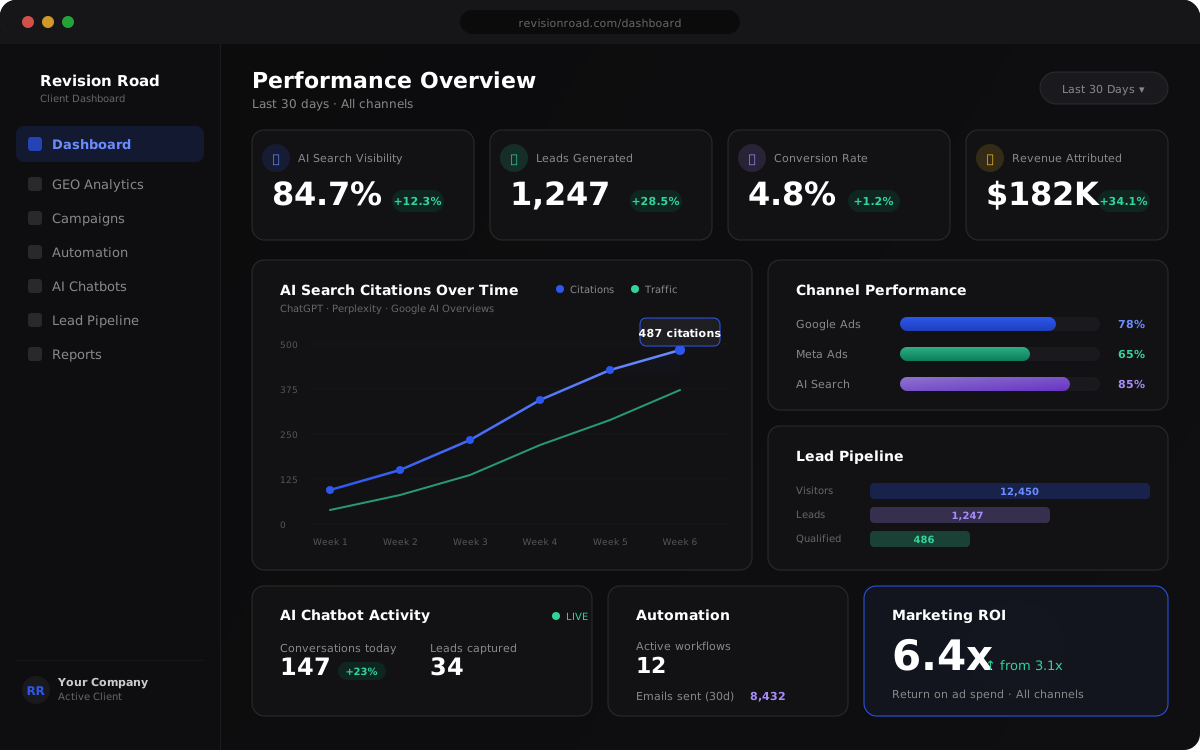
If managing your own hosting sounds like more than you want to take on, there’s another path worth considering. Revision Road offers agency managed web hosting that combines premium infrastructure with hands-on, expert management, so you can focus on running your business while professionals handle the technical details.
Understanding agency managed hosting
Agency managed hosting goes beyond traditional hosting by providing a full-service approach. Instead of simply renting server space, you get a team of experts who actively manage, monitor, and optimize your hosting environment. Think of it as the difference between renting an apartment and having a property management company handle everything from maintenance to security.
Key advantages of Revision Road’s managed hosting
-
Proactive monitoring and maintenance: Your hosting environment is monitored around the clock. Issues are identified and resolved before they affect your visitors, often before you even know there’s a problem.
-
Expert security management: From firewall configuration to malware removal, security is handled by professionals who stay current with the latest threats and best practices. Your site is protected by multiple layers of defense.
-
Performance optimization: The team continuously optimizes your server configuration, caching, and content delivery to ensure your site loads fast for every visitor, regardless of their location.
-
Automatic backups and disaster recovery: Your site is backed up regularly, and in the event of a problem, restoration is fast and complete. You never have to worry about losing your content or data.
-
Scalability on demand: As your business grows and your traffic increases, your hosting environment scales with you. There are no hard limits or unexpected overages, just smooth, reliable performance.
-
Dedicated support: When you have questions or need assistance, you’re working with a team that already knows your site, your business, and your goals. There’s no need to explain your setup to a different support agent every time.
-
WordPress and CMS expertise: For businesses running WordPress or other content management systems, agency managed hosting includes CMS-specific optimizations, plugin management, and update handling that keeps your site secure and performant.
Why choose Revision Road
Revision Road’s approach to managed hosting is built on the understanding that your website is a critical business asset. Their hosting plans are designed to eliminate the hidden costs and risks associated with cheap hosting while providing the peace of mind that comes from knowing your site is in expert hands.
By choosing agency managed hosting, you’re not just paying for server space; you’re investing in a partnership that prioritizes your website’s performance, security, and growth. It’s the kind of hosting that pays for itself through better uptime, faster performance, stronger security, and the time you save by not having to manage it all yourself.
Conclusion
The true cost of cheap website hosting extends far beyond the monthly fee on your invoice. From downtime and security vulnerabilities to poor performance and damaged brand reputation, the hidden costs of budget hosting can significantly outweigh any upfront savings.
Your website is too important to your business to trust to the lowest bidder. Whether you choose to invest in premium self-managed hosting or opt for the comprehensive care of agency managed hosting like Revision Road offers, the key is to recognize that hosting is an investment in your business’s online success, not just an expense to minimize.
Take the time to evaluate your hosting needs honestly, consider the total cost of ownership rather than just the sticker price, and choose a hosting solution that supports your business goals today and into the future. Your website, and your customers, deserve nothing less.