When it comes to building dynamic, content-driven websites, the choice of content management system can make or break your project. While platforms like WordPress dominate the market share conversation, ExpressionEngine has quietly earned a loyal following among developers and organizations that demand flexibility, security, and precision in their web projects.
ExpressionEngine (often abbreviated as EE) is a mature, PHP-based content management system that has been powering websites since 2004. Built by EllisLab and now maintained by Packet Tide, ExpressionEngine is designed from the ground up to give developers complete control over their content architecture, templating, and output, without the bloat and opinionated structures that come with many other CMS platforms.
In this article, we’ll explore what makes ExpressionEngine a smart choice for building dynamic websites, from its powerful content modeling capabilities to its robust security posture and extensible architecture.
Key Takeaways
- ExpressionEngine offers unparalleled flexibility in content modeling, allowing developers to create custom data structures without being constrained by predefined content types.
- Its templating system provides complete control over HTML output, making it ideal for projects that require pixel-perfect implementation of custom designs.
- ExpressionEngine’s security track record is exceptional, with a proactive approach to vulnerability management and a clean architecture that minimizes attack surfaces.
- The platform scales effectively for complex, content-heavy websites that require sophisticated relationships between content types.
- While it has a steeper learning curve than some alternatives, ExpressionEngine rewards the investment with a level of control and customization that few other CMS platforms can match.
The power of ExpressionEngine
ExpressionEngine’s core strength lies in its philosophy: it provides the tools and framework for building exactly what you need, without imposing assumptions about what your website should look like or how your content should be structured. This makes it particularly well-suited for projects that don’t fit neatly into the templates and patterns offered by more opinionated platforms.
Flexibility and customization
ExpressionEngine’s approach to flexibility is fundamentally different from most CMS platforms. Rather than offering a rigid content structure that you must work around, EE provides a blank canvas with powerful building blocks.
Channels are at the heart of ExpressionEngine’s content architecture. A channel can represent any type of content: blog posts, products, events, team members, portfolio pieces, or any custom content type your project requires. Within each channel, you define exactly which fields are needed, what type of data each field holds, and how entries relate to one another.
Key flexibility features include:
- Custom field types: Text, rich text, file uploads, date fields, relationships, grid fields, and many more, each configurable to your exact specifications.
- Template-agnostic output: ExpressionEngine’s templating system doesn’t impose any HTML structure. You write the markup, and EE injects the content. This means your front-end is never constrained by the CMS.
- Multiple site management: A single ExpressionEngine installation can power multiple websites, sharing content and member data across them or keeping them entirely separate.
- Granular permissions: Member groups and roles can be configured with fine-grained access controls, determining who can create, edit, publish, and delete content across different channels and areas of the site.
This level of flexibility means ExpressionEngine can power anything from a simple blog to a complex enterprise application with hundreds of content types and intricate business rules.
Scalability and performance
ExpressionEngine is built to handle growth. Its architecture is designed to perform efficiently even as your content library expands and your traffic increases.
Performance features that support scalability include:
- Tag caching: Individual template tags can be cached independently, allowing you to cache database-heavy content while keeping dynamic elements fresh.
- Template caching: Full templates can be cached as static files, dramatically reducing server load for high-traffic pages.
- Query caching: Database queries are cached to reduce repetitive database calls, improving response times across the board.
- Database optimization: ExpressionEngine’s database schema is well-structured and indexed, supporting efficient queries even with large datasets.
- CDN compatibility: The platform works seamlessly with content delivery networks, enabling global content distribution for geographically distributed audiences.
For organizations with growing content needs and increasing traffic, ExpressionEngine provides a stable, performant foundation that doesn’t require a complete rebuild as your demands increase.
Security and reliability
Security is one of ExpressionEngine’s strongest selling points, and one of the primary reasons it’s trusted by universities, government agencies, and enterprises with stringent security requirements.
ExpressionEngine’s security features include:
- Clean, audited codebase: The platform’s code is regularly audited and maintained with security as a top priority. The smaller codebase (compared to platforms like WordPress) means a smaller attack surface.
- No direct database queries in templates: Unlike some CMS platforms that allow raw SQL in templates, ExpressionEngine’s tag-based templating system prevents SQL injection attacks at the template level.
- Built-in XSS filtering: Cross-site scripting protection is built into the core, sanitizing user input to prevent malicious code injection.
- Secure session management: ExpressionEngine uses robust session handling with configurable security settings for both the control panel and front-end member areas.
- Password security: Bcrypt hashing, configurable password requirements, and brute-force protection are all built in.
- Minimal plugin dependency: Unlike WordPress, where security vulnerabilities frequently stem from third-party plugins, ExpressionEngine’s powerful core reduces the need for external add-ons, minimizing potential vulnerability points.
The platform’s security track record speaks for itself: critical vulnerabilities are rare, and the development team has a history of proactive, responsible security management.
Building dynamic websites with ExpressionEngine
ExpressionEngine truly shines when the project demands dynamic, content-rich websites with complex requirements. Here’s how the platform’s core features support dynamic website development.
Content management and templating
ExpressionEngine’s content management and templating system work together to give developers complete control over how content is created, organized, and displayed.
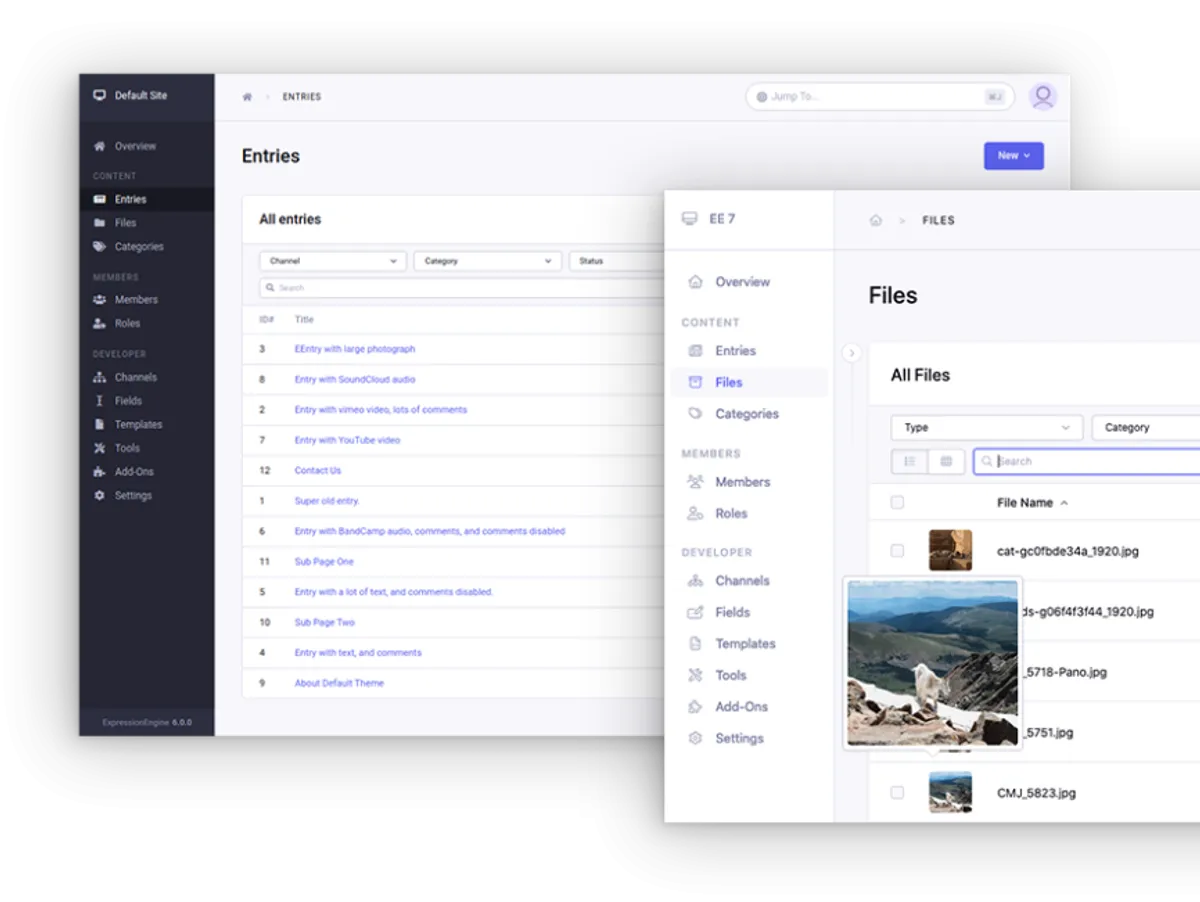
Content management in ExpressionEngine is centered around channels and entries. The control panel provides a clean, intuitive interface for content editors, with customizable publish layouts that show only the fields relevant to each content type. This means content creators aren’t overwhelmed by unnecessary options, and developers can tailor the editing experience to match the project’s workflow.
Templating in ExpressionEngine uses a tag-based syntax that is both powerful and accessible. Templates are organized into groups and can include other templates (partials), use conditional logic, loop through content, and format output, all without requiring PHP or complex programming.
A typical ExpressionEngine template might look like this:
{exp:channel:entries channel="blog" limit="10" orderby="date" sort="desc"}
  <article>
    <h2><a href="{url_title_path='blog/detail'}">{title}</a></h2>
    <time datetime="{entry_date format='%Y-%m-%d'}">{entry_date format='%F %d, %Y'}</time>
    <div>{blog_content}</div>
  </article>
{/exp:channel:entries}
This simplicity in syntax belies the power underneath. The templating system supports:
- Nested tags: Tags within tags for complex data retrieval.
- Conditional logic: Display content based on conditions, member groups, URL segments, or any other criteria.
- Variable modifiers: Format, manipulate, and transform data directly within templates.
- Template layouts: Define base layouts that child templates extend, promoting DRY (Don’t Repeat Yourself) principles.
- Template routes: Map URLs to templates with advanced routing rules.
Data modeling and relationships
One of ExpressionEngine’s most powerful features is its ability to model complex data relationships. In the real world, content rarely exists in isolation. Blog posts have authors, products have categories, events have venues, and team members have departments. ExpressionEngine provides robust tools for defining and managing these relationships.
Relationship fields allow you to link entries across channels. A “project” entry can be linked to “team member” entries, “service” entries, and “testimonial” entries, creating a rich, interconnected content model that reflects the real-world relationships in your organization.
Grid fields enable repeatable content within a single entry. Need a team member to have multiple education credentials, each with an institution, degree, and year? A grid field handles this elegantly without requiring additional channels or complex workarounds.
Categories provide hierarchical taxonomy for organizing content. Categories can be shared across channels or dedicated to specific content types, and they support unlimited nesting depth.
Fluid fields (introduced in ExpressionEngine 4) offer a page-builder-like experience, allowing content editors to assemble pages from predefined content blocks (text sections, image galleries, call-to-action panels, and more) in any order they choose.
Together, these tools enable developers to create sophisticated content architectures that accurately model complex information while keeping the editing experience simple and intuitive for content creators.
Extending functionality with add-ons
While ExpressionEngine’s core is powerful enough for many projects, its add-on ecosystem extends its capabilities further. Add-ons (plugins, modules, extensions, and fieldtypes) can add new features, integrate with third-party services, and customize the platform’s behavior.
Notable categories of add-ons include:
- E-commerce: Add-ons for building online stores, managing products, processing payments, and handling shipping.
- SEO: Tools for managing meta tags, generating sitemaps, and optimizing content for search engines.
- Form building: Advanced form creation and management beyond the built-in capabilities.
- Social media integration: Tools for sharing content, displaying feeds, and managing social interactions.
- Image manipulation: Advanced image processing, cropping, and optimization tools.
- Caching and performance: Additional caching layers and performance optimization tools.
The ExpressionEngine add-on marketplace and community provide a range of both free and commercial add-ons, and the platform’s well-documented API makes custom add-on development straightforward for developers with PHP experience.
ExpressionEngine vs other CMS platforms
Understanding how ExpressionEngine compares to other popular CMS platforms helps clarify when it’s the right choice for your project.
Comparing features
| Feature | ExpressionEngine | WordPress | Craft CMS | Drupal |
|---|---|---|---|---|
| Custom content modeling | Excellent | Limited (requires plugins) | Excellent | Good |
| Template control | Complete | Theme-dependent | Complete (Twig) | Moderate |
| Security track record | Excellent | Frequent vulnerabilities | Good | Good |
| Plugin/add-on ecosystem | Moderate | Extensive | Growing | Extensive |
| Learning curve | Moderate-steep | Low | Moderate | Steep |
| Multi-site support | Built-in | Requires configuration | Built-in (Pro) | Built-in |
| Content relationships | Built-in | Limited (requires plugins) | Built-in | Built-in |
| Community size | Small-medium | Very large | Growing | Large |
| Cost | Licensed (free core) | Free | Licensed (free solo) | Free |
| Hosting requirements | Standard PHP/MySQL | Standard PHP/MySQL | Standard PHP/MySQL | Standard PHP/MySQL |
Advantages for complex websites
ExpressionEngine’s advantages become most apparent on complex, custom projects where the content model doesn’t fit neatly into a standard blog or page structure.
Where ExpressionEngine excels:
- University and education websites: Complex content relationships between departments, programs, faculty, events, and news make EE’s data modeling capabilities essential.
- Government and institutional sites: Stringent security requirements and complex organizational structures align well with EE’s security posture and flexible architecture.
- Media and publishing sites: High-volume content with sophisticated categorization, tagging, and cross-referencing benefits from EE’s relationship and taxonomy tools.
- Corporate sites with multiple brands: Multi-site management allows a single installation to power multiple brand websites with shared or independent content.
- Custom web applications: When the project goes beyond traditional content management into application territory, EE’s flexible architecture and powerful templating provide a solid foundation.
Where other platforms may be a better fit:
- Simple blogs or personal sites (WordPress is typically more efficient).
- Projects that need extensive third-party integrations out of the box (WordPress’s ecosystem is unmatched).
- Sites where the client needs maximum DIY capability with minimal technical knowledge (WordPress or Squarespace may be more appropriate).
Ease of use and learning curve
Honesty is important here: ExpressionEngine has a steeper learning curve than platforms like WordPress or Squarespace. There’s no getting around the fact that EE expects more from its developers. The platform doesn’t hand you a pre-built theme and say “go.” Instead, it gives you the tools to build exactly what you need, but you need to know how to use them.
For developers, this means:
- Learning EE’s tag-based templating syntax (straightforward but unique).
- Understanding the channel/field/entry content model.
- Familiarizing yourself with the control panel and configuration options.
- Potentially learning the add-on development API for custom functionality.
For content editors, the experience is typically excellent once the site is built. A well-configured ExpressionEngine site provides a clean, focused editing interface that shows only what’s relevant and guides editors through the content creation process.
The investment in learning ExpressionEngine pays dividends on complex projects where the flexibility and control save significant time compared to fighting against the limitations of a more restrictive platform.
Conclusion
ExpressionEngine is a smart choice for building dynamic websites when your project demands flexibility, security, and precise control over content architecture and output. Its channel-based content modeling, tag-based templating system, robust security features, and scalable architecture make it particularly well-suited for complex, custom web projects that push beyond the boundaries of template-driven CMS platforms.
While it may not be the right choice for every project (simple sites and projects with limited budgets may be better served by WordPress or a website builder), ExpressionEngine rewards the investment of time and expertise with a platform that can handle virtually any content challenge you throw at it.
If you’re evaluating CMS options for a project that requires sophisticated content modeling, airtight security, and complete creative control, ExpressionEngine deserves a place on your shortlist.
FAQs
What is ExpressionEngine?
ExpressionEngine is a PHP-based content management system (CMS) designed for building custom, dynamic websites. It provides flexible content modeling, a powerful templating system, and robust security features.
Is ExpressionEngine free?
ExpressionEngine offers a free core version that includes fundamental features. A licensed version with additional features and priority support is available for purchase.
How does ExpressionEngine compare to WordPress?
ExpressionEngine offers greater flexibility in content modeling and templating, a stronger security track record, and more granular control over content architecture. WordPress has a larger ecosystem of themes and plugins and a lower learning curve.
Is ExpressionEngine good for large websites?
Yes. ExpressionEngine's caching system, optimized database queries, and scalable architecture make it well-suited for large, content-heavy websites.
What kind of websites is ExpressionEngine best for?
ExpressionEngine excels at websites with complex content requirements, such as university sites, government portals, media platforms, corporate multi-brand sites, and custom web applications.
Can ExpressionEngine be used for e-commerce?
While not primarily an e-commerce platform, add-ons are available that provide e-commerce functionality including product management, shopping carts, payment processing, and order management.